The internet, aided by mobile telephony, sparked a revolution in how the world communicates. Together, this technology gave us the ability to talk to friends and colleagues wherever we or they may happen to be at the time, and to send and receive information from the palm of our hand: everyone, it seems, is constantly on their phones, reading and writing.
Odd, then, with so much reading and writing going on, that there should be so much talk of declining literacy in the modern age.
Perhaps the problem is not how much reading and writing people engage in, but the nature and quality of it.
In 16th century England, people who could read almost exclusively consumed the bible. Not exactly light reading material, I’m sure you would agree. But driven by an explosion in the availability of printed bibles and a strong desire (or compulsion) to read them, it is thought that up to 50% of the adult population could read at that time, although fewer than 10% of men (and even fewer women) could sign their name, let alone write a sentence.
Between 1851 and 1900, thanks to the efforts of various literacy champions, spearheaded by Charles Dickens and capped by the 1870 Education Act, there was a meteoric rise in male and female literacy to around 97% for both genders.
That’s not to say that everyone was able to wade through Bleak House or to compose prose-dripping love letters to each other, but they possessed – at a minimum – basic literacy. This fuelled a huge rise in the number and variety of newspapers and magazines, and of popular novels, and with it the pleasure of recreational reading.
Today, the UK’s literacy rate is a recorded 99%. So, it seems we’re doing very well!
However, this metric tracks basic alphabetical literacy (at age 15+), measuring the proportion of people who can read and write a simple, short statement about their everyday life.
Doesn’t sound so impressive now, does it…?
Digging deeper, we see that primary-aged children in England consistently perform very highly in international testing – up there in the top four or five countries of the world. Yet the UK-wide GCSE results for 2026 show that only 59.5% of students achieved a ‘pass’ (grade 4/C or above) in English Language – much lower than the average pass rate for all subjects.
Why? What happens to our world-leading literates between leaving primary school and taking their GCSEs?
Puberty, sure. But that’s always been a thing.
Let’s go deeper. According to the most recent literacy statistics for England, fully 18% of adults were assessed at level 1 or below, meaning they have very poor literacy skills. At the top end, 14% of adults scored at levels 4 or 5, meaning they have the skills to understand and evaluate long, dense pages of text, and to grasp complex or hidden meanings. Sounds a lot like the bible, doesn’t it?
Could it really be true that up to 50% of the population could read a tome like the bible 500 years ago, but today only 14% could manage it? Probably not: it’s an unfair comparison. But given that only 14% of adults scored in the top two levels, it follows that 86% scored at level 3 (possessing just average literacy skills) or lower.
What’s really concerning is that, back when the only book most people had access to was the bible, they read it on a daily basis. Compare that with today’s research, which tells us that only 20.3% of 8- to 18-year-olds read something daily in their free time.
Is that because there’s nothing they want to read? Surely not – from Harry Potter and a plethora of popular children’s books by celebrity authors, to action-packed thrillers and fantasy galore aimed at older teenagers (not to even mention magazines), there’s more available to entice young readers than ever before.
Yet, that same research tells us that only around 36% of them enjoy reading in their free time. Added to that, just 28.7% of young people aged 8 to 18 recorded that they enjoy writing in their free time, compared with 50.7% ten years ago.
And that seems to be the rub of it. Most young people today simply don’t like reading or writing for pleasure, and the explosion of the social media ‘swipe culture’ over that period is surely a major contributing factor. Transferring this into their everyday adult lives, they’re a generation that only wants the highlights, with little patience to engage with detail.
We can see that with news. We used to be a nation of avid newspaper readers – we habitually consumed them, almost cover to cover. How many people today read actual newspapers? Most get their news online, often relying on pop-ups and AI summaries.
Even proper news websites are increasingly relying on short-form reporting: video highlights, basic explainers, and ‘what you need to know’ snippets. Major world-shaking news is often presented not as an in-depth report, but as a list of bullet points that open ‘posts’, with the bullet points themselves merely sequential teasers.
Everything broken down into itty-bitty bite-sized pieces, because apparently that’s all most people can cope with reading these days.
As for writing, the 2 billion letters that ordinary soldiers wrote home from the trenches during WW1 tell their own story. Many thousands of those letters have survived to find their way onto family history websites, and the difference between then and now is clear to see. In the space of around 110 years, competent letter writing has gone from a common skill to a rare commodity: eloquence abandoned, punctuation scorned, and grammar trashed.
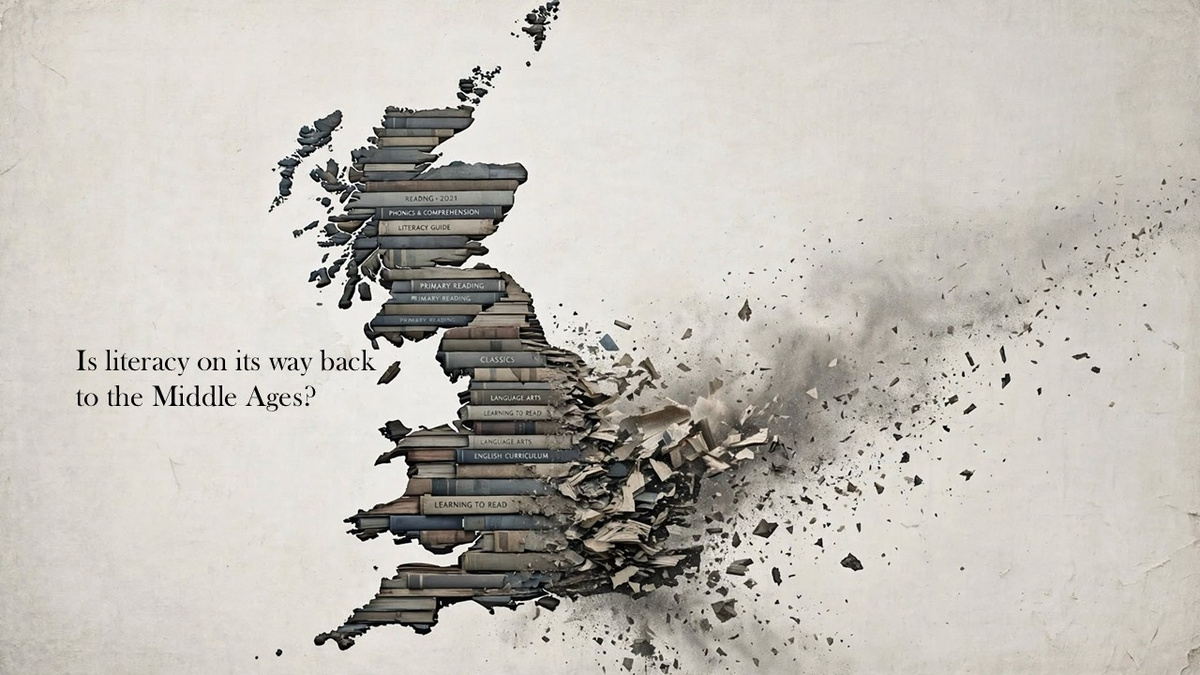
Is literacy on its way back to the Middle Ages? I doubt things will get quite that bad, but it does seem that we’re well on the way to producing an entire generation of functional illiterates.